
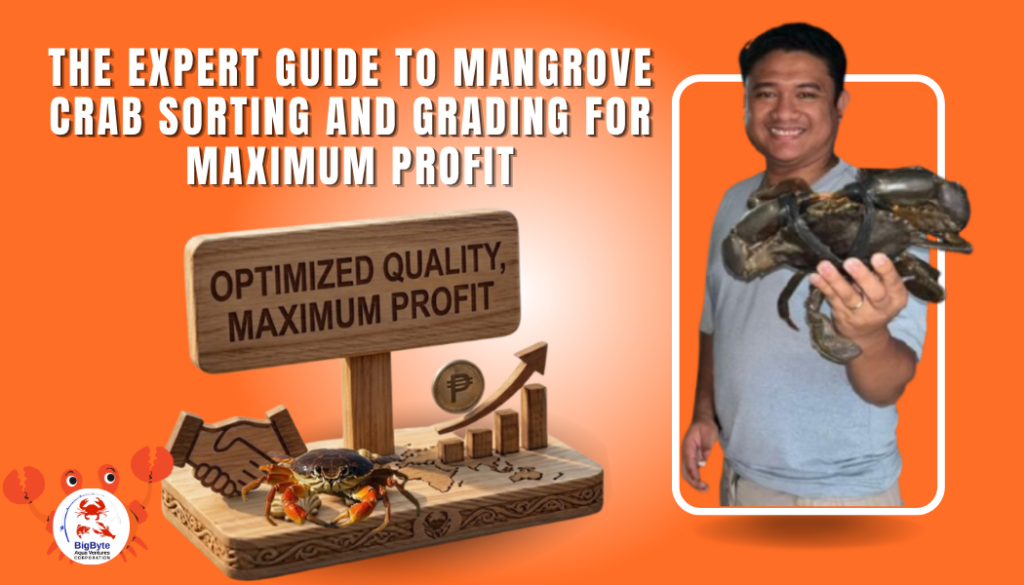
The value of your harvest is determined long before it reaches the market. Successful farmers know that consistent mangrove crab sorting and grading is the essential foundation for a profitable business. By meticulously evaluating each crab based on its physical condition, meat content, and shell hardness, you can ensure that only the premium “Good Quality” stock moves forward, while identifying Class B and C crabs that may require further attention or lower market pricing.
Implementing a rigorous system for mangrove crab sorting and grading allows you to manage your inventory with precision and meet the specific demands of buyers. From identifying the species, whether it’s the Scylla Serrata (Green Crab) or Scylla Olivacea (Pulahan)to checking for the presence of ‘aligue’ (fat), these standards help maintain a reputation for excellence. In this guide, we will break down the criteria for quality and the sampling techniques needed to optimize your production cycle.
Understanding Quality: Criteria for Sorting
Not all crabs are created equal. To maximize your return on investment, you must categorize your harvest into specific quality tiers based on physical integrity and “fatness.”
1. Criteria of Good Quality
A premium crab is one that is fully fattened and physically intact.
- Grade A: Fattened crab with complete body parts and rich ‘aligue’.
- Acceptable: Fattened crab with only one leg detached is still considered high quality in many markets.
2. Rejected Quality / Class B & C
Crabs that fall into these categories often fetch a lower price due to physical defects or lack of meat:
- Physical Damage: One claw detached, distorted claws, or broken shells.
- Successive Loss: Two or more succeeding legs detached.
- Thin Crabs: Crabs that are “payat” (thin) despite having complete body parts.
Sampling, Sizing, and Harvest Timing
Efficiency in a crab farm is built on regular monitoring. You cannot manage what you do not measure, which is why sampling is vital.
- The 20-Day Rule: The first sampling should be performed 20 days after stocking, followed by succeeding checks every 10 days.
- The Physical Test: To check for fatness, take the crab out of its box and press the abdominal part and the bottom of the lateral spine.
- Hard: The crab is fully fattened and ready.
- Soft: The crab is still thin and needs more time.
- Undecided: Return to the box for a few more days.
- Hard: The crab is fully fattened and ready.
- Average Harvest Time: Typically, a well-managed system reaches peak harvest maturity in 1 month.
Maintaining a strict schedule for these checks ensures that you do not harvest too early, which results in “payat” crabs, or too late, which wastes feed and resources.
Gender Identification and Species Variety
The market price of crabs depends heavily on gender and species. Recognizing these differences during the sorting process is a mandatory skill for any aqua-entrepreneur.
Identifying Gender
- Male: Noted for having a narrow abdominal flap.
- Female: Features a much broader, rounded abdominal flap.
- Bakla: An intermediate gender type often prized for its specific fat content.
Checking for ‘Aligue’ (Fat)
For female and bakla crabs, you can slightly open the abdominal flap while they are tied to check the color of the fats:
- Orange (Female): Fully fattened and premium.
- Yellow (Female): Half fattened.
- Yellow (Bakla): Fully fattened.
Knowing whether you are farming Scylla Serrata, Scylla Paramamosain, Scylla Olivacea, or Scylla Tranquebarica is equally important, as each species has unique growth rates and color characteristics that buyers look for.
Mastering the nuances of crab quality is a journey of constant observation and refinement. By adhering to these professional standards for sizing, gender identification, and shell integrity, you protect your investment and ensure your customers receive only the best product. A disciplined approach to your farm’s sorting protocols will directly translate into higher market trust and better financial margins.
Take Control of Your Harvest Today
Ready to elevate your aquaculture business to the next level? Don’t leave your profits to chance. Start implementing these professional sorting techniques today and ensure every crab you sell is a testament to quality.
Website: www.bigbyteaquaventures.com
Facebook: BigByte Aqua Ventures
Phone: +63 948 056 4792
Get in touch with us today:
Contact BigByte Aqua Ventures for more expert guidance on mud crab farming and RAS technology