Recirculating Aquaculture System (RAS) requires more than just high-end technology; it demands a precision-timed routine. In this high-density environment, mastering your vertical crab farming RAS routine is the thin line between a high-yield harvest and system failure. To achieve maximum growth and high survival rates, you must balance aggressive nutritional intake with meticulous sanitation to ensure every crab thrives in its individual box.
The secret to a successful facility lies in a strategic timing protocol for feeding and cleaning. By following a strict rhythm, you synchronize the crabs’ metabolic needs with the system’s filtration capacity, preventing toxic spikes and keeping the water crystal clear. This guide given by Bigbyte Aqua Ventures breaks down the essential daily timeline, nutritional strategies, and the critical water quality parameters necessary to transform your vertical crab farming RAS routine into a peak-performance operation.
The “Golden Rule” Routine: The 2-Hour Cycle
In a vertical RAS, water management is your top priority. By following a strict 2-hour interval between feeding and cleaning, you ensure that uneaten organic matter doesn’t decompose, keeping your water chemistry stable and safe.
The Morning Cycle (The Foundation)
- 05:00 AM – 06:00 AM | Early Start: Begin by removing fecal waste from the boxes. Follow immediately with the Morning Feeding (25% of the daily ration).
- 08:00 AM | Secondary Feeding: Exactly two hours later, provide a second feeding. This ensures all crabs, including the less aggressive ones, are well-fed.
- 10:00 AM | Precision Cleaning: Two hours after the second feeding, perform a deep clean. Remove all uneaten food and debris to maintain pristine water quality.
The Evening Cycle (The Growth Phase)
- 05:00 PM – 06:00 PM | Nighttime Feeding: Clear out any waste and provide the main meal. Since crabs are naturally nocturnal, this is their largest portion (75% of the daily ration).
- 08:00 PM | Secondary Feeding: Two hours after the initial evening meal, provide the second portion of the night cycle.
- 10:00 PM | Final Sanitation: Two hours after the last meal, do the final cleaning. This is critical for water management, as it prevents ammonia spikes while the system runs overnight.
Maintaining this rigorous two-hour interval between feeding and cleaning is the most effective way to prevent organic buildup and stabilize your system. By aligning your routine with the crabs’ natural nocturnal behaviors and keeping a strict eye on water chemistry, you ensure a high-yield, healthy harvest. Consistency is the key, stick to the schedule, manage your water quality, and your vertical crab facility will thrive.
Feeding Management: Fueling Fast Growth
Crabs are omnivorous and opportunistic. To speed up the “fattening” process, variety and protein are your best friends.
- The Menu: Feed a diverse mix of Trash Fish, Squid, Golden Kuhol (Snails), Animal Meat/Entrails, Shells (Mollusks), Boiled Corn, and Commercial Pellets.
- Nutrition: Always prioritize high protein content. It is the primary driver for faster growth and higher weight.
- The Ratio: Feed 3–5% of the crab’s body weight daily. For example, a 500g crab should receive 15g–25g of food total per day.
Water Management: The 10 Essential Parameters
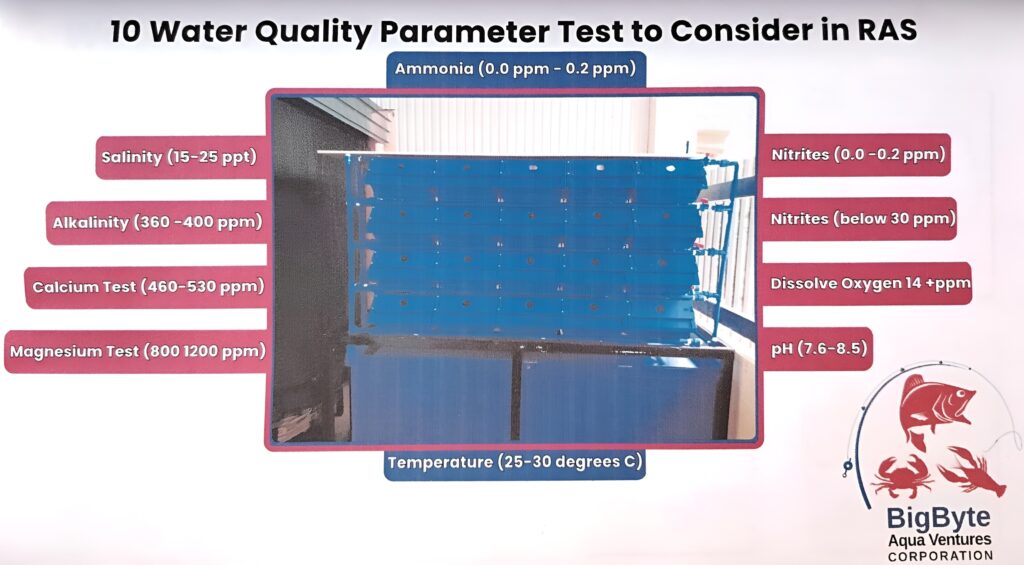
Your water is the life-support system for your stock. You must monitor these 10 parameters during your AM and PM checks to ensure a suitable fattening environment.
The Core Parameters
- Salinity (15 – 25 ppt): Measures the salt content in parts per thousand. This is one of the most critical parameters for crab health.
- Water Temperature (25 – 30°C): Crabs tolerate 20 – 35°C, but 25 – 30°C is the suitable temperature for fattening. Temperatures below this range can significantly slow growth.
- pH Level (7.6 – 8.5): Measures acidity and alkalinity. While crabs tolerate 6.5 to 9.0, the higher the pH, the more toxic the ammonia becomes, posing a major risk to survival.
- Dissolved Oxygen (4+ ppm): Oxygen levels must stay above 4 ppm for crabs to thrive in a submerged system.
Chemical & Mineral Balance
- Ammonia / TAN (<0.2 ppm): Total Amount Nitrogen (NH3 and NH4+). Safe levels must stay below 0.2 ppm to avoid mortality.
- Alkalinity (360 – 400 ppm): Total alkaline materials. High alkalinity increases ammonia toxicity.
- Management Tip: Use lime or alkaline materials to stabilize levels. Remember: “The higher the alkalinity, the higher the pH level.”
- Management Tip: Use lime or alkaline materials to stabilize levels. Remember: “The higher the alkalinity, the higher the pH level.”
- Nitrites (0.0 – 0.2 ppm): A byproduct of waste; keep as close to zero as possible.
- Nitrates (Below 30 ppm): Managed through the RAS filtration and water changes.
- Calcium (460 – 530 ppm): Vital for shell health and successful molting.
- Magnesium (800 – 1200 ppm): Essential for mineral balance and metabolic function.
Daily Success Checklist
- Monitor AM/PM: Conduct water quality tests, stock new crabs, and harvest mature ones every day.
- The pH-Ammonia Link: Always watch your pH; as it rises, ammonia becomes much more dangerous to your crabs.
- Consistency is Key: A disciplined water management routine is the most effective way to ensure a high-yield, profitable harvest.
Ready to Scale Your Crab Production?
Don’t leave your harvest to chance. Implement this precision routine today to stabilize your water quality and accelerate crab growth. Whether you are stocking new boxes or monitoring your daily parameters, consistency is the difference between a struggling system and a high-profit facility.
Get in touch with us today:
Website: www.bigbyteaquaventures.com
Facebook: BigByte Aqua Ventures
Phone: +63 948 056 4792
Contact us today to learn more about optimizing your vertical crab facility and securing the best feeds for your RAS!